The short answer
Expand section
The short answer
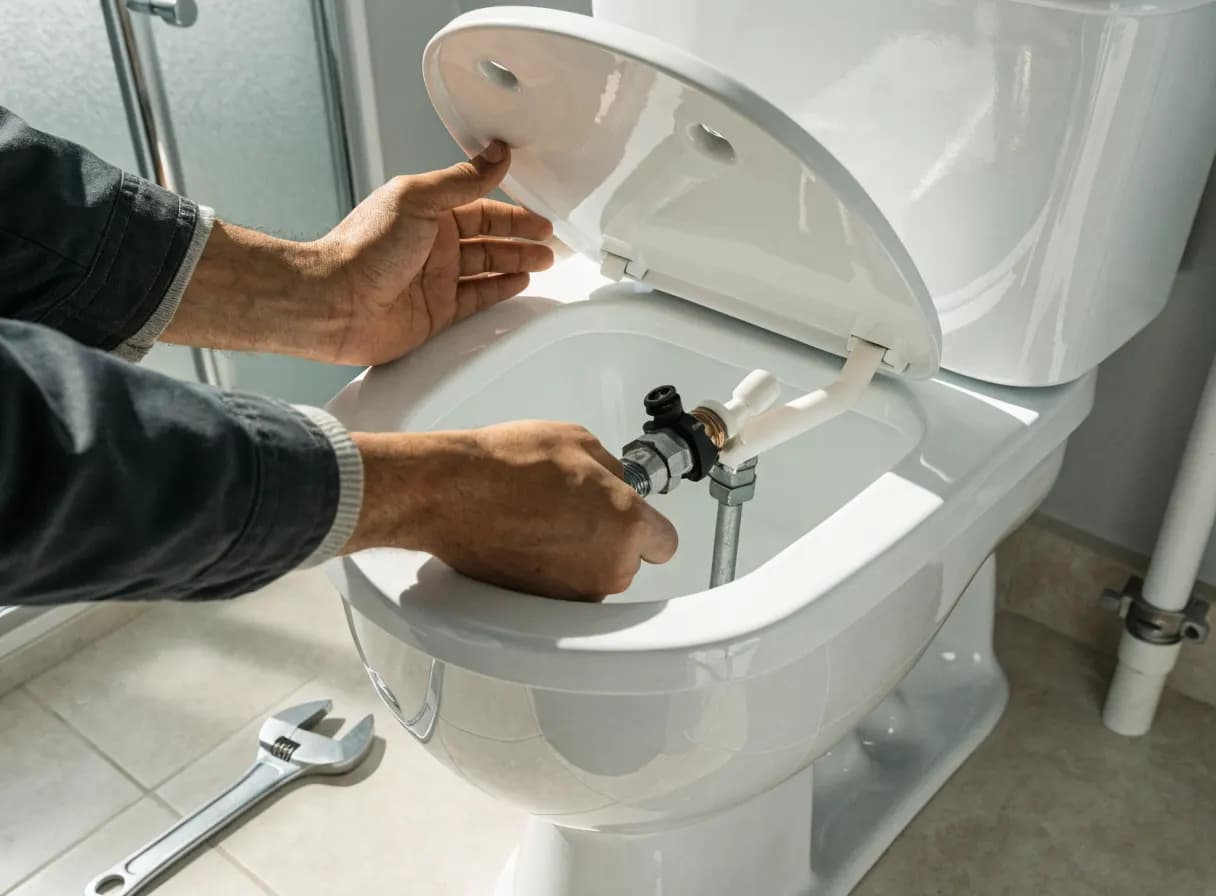
Almost every toilet complaint traces back to five causes, and four of them cost less than $25 in parts. A worn flapper or a tired fill valve makes it run. A failed wax ring makes it leak at the base. Loose bolts or a bad flange make it rock. Mineral buildup makes it flush weakly. The fifth cause, water finding the floor, is the one that gets expensive when ignored. This guide walks through diagnosing each one, what the fix involves, and the honest line where DIY should stop.
The running toilet
Expand section
The running toilet
A running toilet is the most expensive cheap problem in a house: hundreds of gallons a day through a $10 part. Lift the tank lid and watch. If water is trickling over the top of the overflow tube, the fill valve is set too high or not shutting off; adjust the float or replace the valve. If the water level is fine but the toilet still refills periodically, the flapper is leaking.
The dye test settles it: a few drops of food coloring in the tank, wait twenty minutes without flushing, and look in the bowl. Color means the flapper is passing water. Replace it, and while you are there, run a finger around the valve seat it seals against; a rough or mineral-crusted seat chews through new flappers and wants cleaning or a seat repair ring.
Phantom flushes
Expand section
Phantom flushes
A toilet that refills by itself at 2 a.m. is not haunted, it is siphoning. The flapper leak from the previous section, running slowly enough that you never hear it, drains the tank over an hour or two until the fill valve wakes up and refills it. The fix is the same flapper-and-seat service, and the dye test is again the diagnosis.
Phantom flushing deserves urgency for one reason: it runs around the clock. A slow flapper leak can move more water in a month than a family uses on showers, and on Treasure Valley summer water rates that shows up on the bill.
The weak flush
Expand section
The weak flush
Flushes fade in this valley for a predictable reason: our water is hard, and minerals close the jets that drive the flush. Water enters the bowl through small rim jets and a siphon jet at the bottom. Scale narrows them year by year until the swirl is lazy and two flushes become normal. A mirror will show crusted rim jets; vinegar, time, and a stiff brush open most of them again.
Rule out the simple things too: tank water below the fill line, a flapper chain so loose the flapper drops early, or a flapper adjusted to close too soon. To separate a jet problem from a drain problem, pour a bucket of water briskly into the bowl. A strong bucket flush with a weak handle flush points at the tank and jets; a weak bucket flush points at a partial clog in the trap or drain.
The rocking toilet
Expand section
The rocking toilet
Rocking is the problem that pretends to be cosmetic and is not. Every rock flexes the wax ring that seals the toilet to the drain flange. Enough movement and the seal opens, letting a little water escape under the toilet with each flush, under the flooring, into the subfloor, invisibly. The soft floor discovered a year later costs fifty times what the wobble would have.
Diagnosis is quick: check whether the closet bolts at the base are loose, whether the flange under them is cracked, or whether the floor is simply uneven. Loose bolts get snugged gently, porcelain cracks under enthusiasm. An uneven floor gets proper shims, not a folded napkin. And any toilet that has been rocking for a while should come up for a new wax ring while the cause is fixed, because the old seal has already been worked loose.
Leaks: base, tank, and supply
Expand section
Leaks: base, tank, and supply
Find where the water starts, not where it ends up. Three origins cover almost everything. Water at the base that appears after flushing is the wax ring. Water dripping from the tank-to-bowl junction is the tank bolts or the spud washer between tank and bowl. Moisture at the wall is the supply line or the shutoff valve, both of which age poorly, especially the multi-turn valves in homes from the 1990s and earlier.
Condensation impersonates all three in summer: a cold tank in a humid bathroom sweats, and the drips collect at the base looking exactly like a seal failure. Dry everything, lay paper towels, flush, and watch where the first moisture appears. And treat any wetness plus a soft floor as a stop sign; that combination means the leak has been running longer than today.
Repair or replace the whole toilet
Expand section
Repair or replace the whole toilet
Parts-level repair wins until the porcelain itself is the problem. Flappers, fill valves, flush valves, seats, and supply lines are all replaceable indefinitely. Replace the fixture when the bowl or tank is cracked, when an old low-quality unit clogs chronically, or when a pre-1994 high-volume toilet is costing real water every day; modern units flush better on far less.
Labor to swap a customer-supplied toilet typically runs $200 to $400 in the valley, and it is worth doing the wax ring, bolts, and supply line as a package while the old one is out. This is standard minor plumbing repair territory, the same lane as the faucet work covered in replacing faucets and fixtures.
When to call someone
Expand section
When to call someone
The stop-DIYing signals are about water and floors, not difficulty. Call a pro when water is reaching the floor and you cannot say from where, when the floor flexes near the toilet, when the shutoff valve will not close or starts weeping when touched, when the flange is cracked or the closet bolts spin freely, or when the same repair has failed twice, because the second failure means the diagnosis was wrong.
A toilet repair visit in the Treasure Valley typically lands between $120 and $350 depending on what the fix turns out to be, and bundling it with the rest of the bathroom's small complaints, a slow drain, tired caulk, a loose towel bar, makes the trip earn its minimum, as laid out in what small home repairs cost in Boise.
Get it fixed in one trip
Expand section
Get it fixed in one trip
Describe the symptom, running, rocking, weak, or wet, send a photo of the toilet and its shutoff valve, and we will quote the likely fix upfront and bring the parts for the probable causes so one trip finishes it. Start at the contact page or see the scope of our minor plumbing repairs service.