Day one: learn the three shutoffs
Before anything breaks, find the main water shutoff, the breaker panel, and the gas shutoff, because every genuine home emergency is ended by one of those three. The water main is usually in the crawl space, the garage, or at the meter box near the street; turn it once so you know it moves. The breaker panel should be labeled, and if the previous owner left you hieroglyphics, an hour with a helper and a lamp fixes that. The gas shutoff sits at the meter and takes a wrench; you will likely never touch it, and knowing where it is costs nothing.
While you are at it: test every smoke and CO detector, read the water heater's data plate for its age (ten-plus years means start planning), and take phone photos of the panel, the water heater label, and the furnace label. Those photos will answer half the questions any pro asks you for the next decade.
What actually breaks first
The first repairs in almost every house are small, wet, or moving: toilets that run, faucets that drip, doors that stick, caulk that opens, outlets that die because a GFCI tripped somewhere else. None of these mean you bought a lemon. Houses are machines with thousands of parts, the cheap consumable parts fail first, and the Treasure Valley adds its own list: hard water scales up fixtures faster than soft-water regions, dry summers and freezing winters cycle caulk and wood joints, and newer homes in Meridian, Kuna, and Nampa subdivisions spend their first two years settling, hairline drywall cracks, drifting doors, nail pops.
Here is the honest triage for the first-year usual suspects:
| Symptom | Usually means | DIY or pro | Typical cost if pro |
|---|---|---|---|
| Toilet runs after flushing | Worn flapper or fill valve | DIY-friendly | $100 to $200 |
| Faucet drips | Worn cartridge | Either | $100 to $250 |
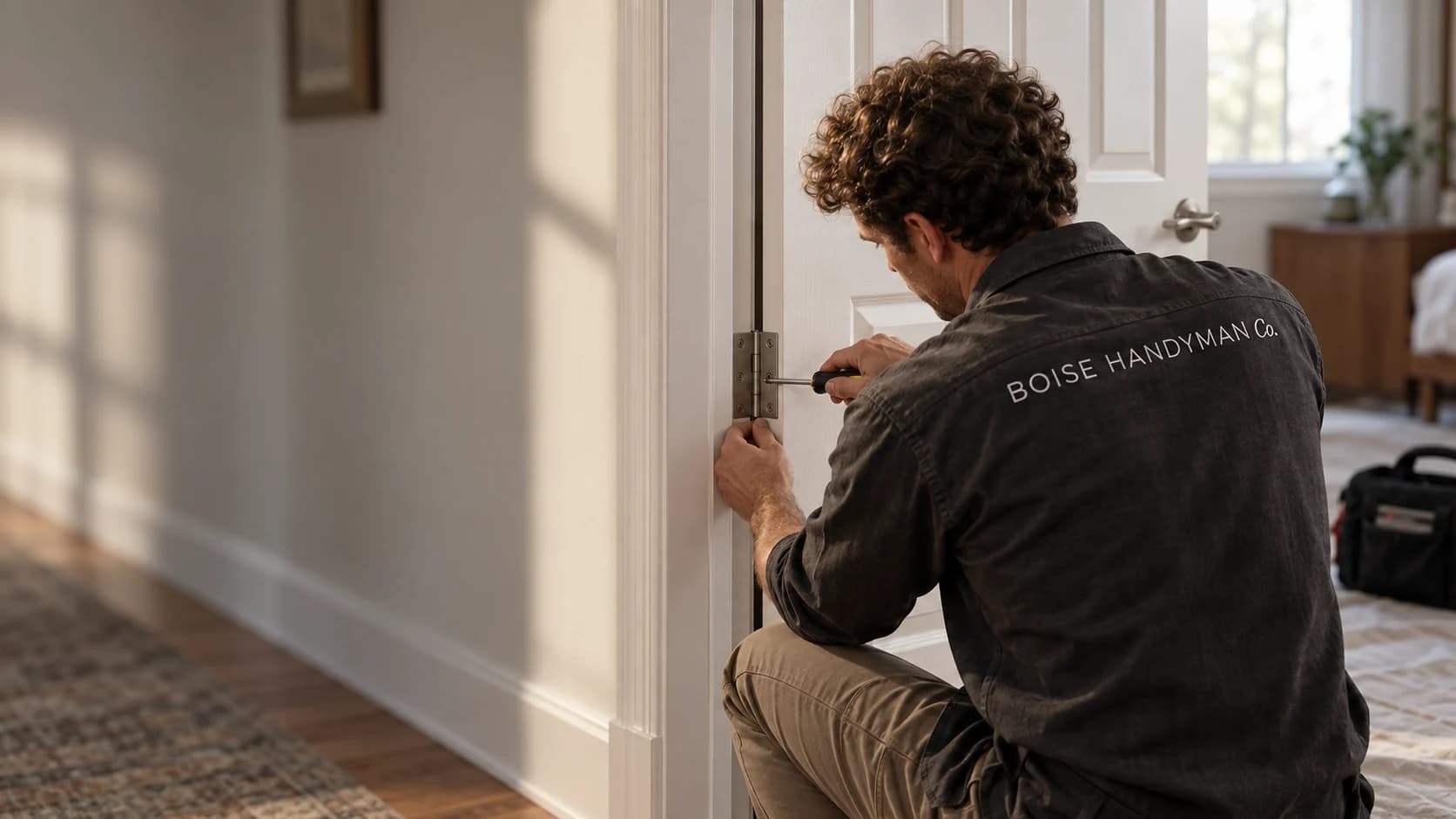
| Door sticks or will not latch | Settling, hinge wear | Either | $75 to $200 |
| Outlet dead, others fine | Tripped GFCI upstream | DIY: find and reset it | $75 to $150 if failed |
| Hairline cracks at drywall corners | Normal settling | Pro for invisible finish | $100 to $300 |
| Caulk pulling away in tub or shower | Age, movement | Either | $100 to $250 |
| Water stain on ceiling | Leak above: roof, bath, or line | Pro, this week | Depends on source |
The one rule: water never waits
If this handbook compresses to a single sentence: anything involving water gets attention within the week. Water is the engine behind nearly every expensive repair a house can need, rotted framing, ruined subfloor, mold, failed drywall, and it always starts as something small and visible: a stain, a bubble, a musty cabinet, a running toilet, a caulk line that opened. Found early, these are $100-to-$300 fixes. Deferred a season, they multiply by ten, and the multiplier is not a scare tactic, it is the arithmetic of what water does to wood and gypsum while nobody watches.
Build the five-minute monthly habit: touch the back corners under every sink, glance at ceilings below bathrooms, look at the floor around the water heater and toilets, and walk the outside after a hard rain to see where the gutters are putting the roof's water. What to do each season, beyond watching, is the subject of the complete Boise home maintenance guide.
The safe-DIY list, and why it is safe
A repair is safe to DIY when three things are true: the failure mode is cheap, the utilities involved can be positively shut off, and no ladder is doing anything interesting. That test admits a genuinely useful list: furnace filters, toilet flappers and fill valves, tub and shower caulk, hinge and hardware tightening, nail-hole patching, plunger-and-hand-snake drain clearing, GFCI and breaker resets, weatherstripping, and paint touch-ups. Learn these and you will handle half of what your house throws at you, and each one teaches you something about how the house works.
Do them with the cheap insurance habits: shut off the water at the fixture stop before opening anything wet, kill the breaker and verify with a tester before unscrewing anything electrical, and keep the old part until the new one has worked for a week. YouTube is genuinely good for these jobs; the trick is watching two different videos before touching anything, because the differences between them are where your house's surprises live.
One valley-specific DIY habit earns its own mention: hard-water care. Treasure Valley water is mineral-heavy, and the scale it deposits is behind half the fixture complaints in any house here, showerheads that spray sideways, aerators that slow to a dribble, toilets that hiss and run. The countermeasures are the easiest DIY in this handbook: unscrew and vinegar-soak aerators and showerheads a couple of times a year, wipe scale off fixture bodies before it etches, and treat a stiffening toilet fill valve as a $15 part to replace rather than a mystery to live with. Learning this rhythm early means half the "plumbing problems" your house will ever show you get solved at the kitchen sink with a glass of vinegar.
The call-a-pro list, and why it is not about skill
The pro line is drawn by asymmetry, not difficulty: some jobs cost $200 to have done and $2,000 to have done wrong. Wiring beyond a confident like-for-like fixture swap, because the failure mode is fire. Plumbing beyond what a shutoff valve isolates, because the failure mode is the ceiling below. Gas, always. Roofs and second-story ladder work, because the failure mode is you. And finish work that must disappear, texture-matched drywall, stain-matched trim, clean long caulk lines, because the redo costs more than the do.
For calibration on prices before you call anyone: the Boise home repair cost guide carries typical Treasure Valley ranges for all of it, and how to hire a handyman covers vetting whoever you call, including us. Most of the list above lands between $100 and $500, which is the going rate for never thinking about the problem again.
Emergency or Tuesday problem: the honest sort
Only four situations need same-day help: water you cannot stop, gas smell, electrical burning or sparking, and no heat in freezing weather. For water, close the fixture stop or the main, and the emergency is over, what remains is an urgent appointment. For gas, leave the house and call the gas company from outside. For sparking or burning smells, kill that breaker and call. For a dead furnace in January, call an HVAC company and open the taps to a trickle if the cold is severe.
Everything else, the dead outlet, the drip landing in a bucket, the crack over the door, is a Tuesday problem: schedule it this week and stop losing sleep. Knowing the difference is worth real money, because after-hours emergency rates are premium rates, and most of what panicked new homeowners pay them for could have waited for morning with a shutoff turned.
Build the contact list before you need it: a plumber, an electrician, an HVAC company, and a handyman, saved in your phone with notes on who recommended them. The worst time to vet a tradesperson is ankle-deep at 9 p.m., and the neighbors who have owned on your street for a decade have already done the vetting for you, asking them is the single fastest shortcut in this chapter.
The dozen tools worth owning
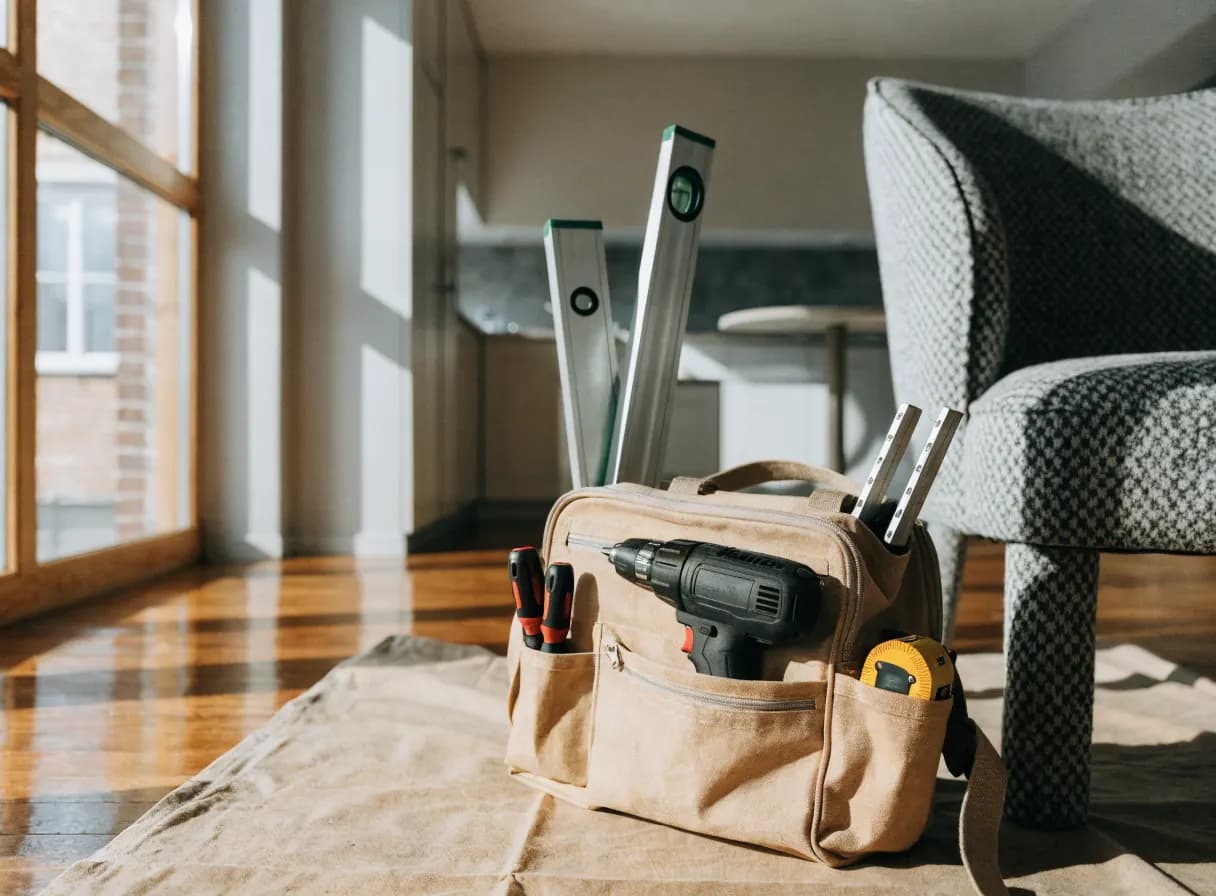
You do not need a contractor's garage; you need about twelve things, bought mid-range. A drill/driver with a bit set does the most work per dollar of anything you will own. Around it: stud finder, 25-foot tape, torpedo level, adjustable wrench, slip-joint pliers, a screwdriver set with real tips, utility knife, caulk gun, a proper plunger, a headlamp, and a step stool rated for adults. Add a $15 outlet tester and a small wet/dry vac and you are equipped past ninety percent of homeowner tasks.
The discipline is what not to buy: any specialty tool a single job demands is a rental or a reason to hire the job out. A tile saw used once is the most expensive way to learn you dislike tiling.
A note for new-construction owners
A brand-new house is not a zero-maintenance house; it is a house in its settling years. Expect hairline drywall cracks at corners and above openings, doors that drift out of alignment, nail pops, and builder-grade caulk shrinking at trim and tubs, all normal, all cosmetic, all worth fixing once the first year or two of movement has happened rather than immediately. The important administrative task: know what your builder warranty covers and when it expires, typically at one year, and walk the house with a list before that date.
Whatever the warranty does not catch becomes a classic punch list, and one-visit punch-list work is exactly what our home maintenance service exists for: settling cracks patched and painted, doors re-hung true, caulk lines redone properly.
The one-hour walkthrough that pays for itself
In your first month, walk the house once with a notebook and no agenda except learning it, because a house you can describe is a house you can triage over the phone. Inside: open every window and note which ones stick or will not lock; run every faucet hot and cold and watch the drains; flush every toilet and listen for one that keeps running; test every outlet with a $15 tester and mark any that are dead, loose, or reversed; find which switch controls what, including the mystery ones; and look inside every under-sink cabinet with a light. Note the model numbers of the furnace, water heater, and disposal while you are at it, photos are enough.
Outside: walk all four sides and note where the ground slopes toward the house instead of away, where the hose bibs are, where downspouts discharge, which fence posts move when pushed, and what the caulk looks like around windows and doors on the sunny sides. None of this requires expertise; it requires an hour and honesty about what you see. The output is your house's baseline, and it does two jobs: it becomes the first draft of your repair list, sorted by the triage rules above, and it means that when something changes later, a new stain, a new crack, a door that suddenly sticks, you will know it is new, which is exactly the information a pro needs to diagnose it quickly.
Your first year, season by season
A first year of ownership in the Treasure Valley has a predictable shape, and knowing it in advance converts most surprises into calendar items. If you closed in summer, your first test is fall: gutters cleaned after leaf drop, hoses disconnected, hose bibs insulated, sprinklers blown out before the first hard freeze in mid-to-late October, and the furnace filter swapped before five months of continuous running. Winter is observation season, watch for ice dams at the eaves, condensation on sills, and drafts worth noting for the caulk gun. Spring is the audit: walk the exterior to see what freeze-thaw did to fences, caulk, and paint, and start the sprinklers zone by zone looking for winter damage. Summer is project season, when the dry months make exterior paint, stain, and fence work easy to schedule.
That full calendar, with the task-by-task detail, is the complete Boise home maintenance guide, and the printable version is on the resources page. The first-year special: whatever season you start in, do that season's list first and backfill the rest as they arrive. By the first anniversary you will have run the whole loop once, and the second year is easier than the first in exactly the way the tenth is easier than the second.
Know what kind of house you bought
The repair list you inherit depends on the decade your house was built, and the Treasure Valley sells every decade. A new build in Meridian, Kuna, or Star hands you the settling program: hairline cracks, drifting doors, shrinking caulk, plus a builder warranty worth documenting against before it expires. A mid-life home in Eagle, Star, or suburban Nampa hands you the replacement wave: original fixtures and weatherstripping reaching the end of their design lives together. An older home in Boise's North End or near the downtowns of Nampa or Caldwell hands you plaster, original wood windows, mature-tree gutters, and the possibility that any opened wall reveals a previous owner's creativity, which is when the licensed-trade referral matters most.
We wrote a guide for each area's housing stock: Boise, Meridian, Eagle, Nampa, Kuna, Star, Middleton, and Caldwell. Reading the one for your area is the fastest way to know which of this handbook's chapters your house will assign you first. Two valley-wide constants apply to every decade: hard water that scales fixtures on a schedule, and a seal-up before winter that always pays.
A short word on permits
Most of what this handbook covers needs no permit at all, and knowing where the line sits keeps you out of trouble on the few things that do. Painting, patching, caulking, hardware, and like-for-like fixture swaps are permit-free everywhere in Ada and Canyon County. Permits enter when work moves or adds wiring, plumbing, or structure, new circuits, relocated pipes, wall removal, water heater replacement, and at that point you are usually in licensed-trade territory anyway. The full picture, including who to call in each county to check a borderline case, is in when a home repair needs a permit, with a printable version on the resources page.
Keep a list, not a panic
The calm way to own a house is a running list: things go on it when noticed, and it gets cleared in batches. Small jobs share trip costs, so five items in one visit costs far less than five visits, and the list itself converts anxiety into scheduling. Our repeat clients run exactly this pattern, a list on the fridge, a call when it hits four items or a season changes.
When the list is ready, send it over with photos. You will get a flat quote before anyone is in your house, the visit handles the whole list in one trip, and anything on it that genuinely needs a licensed trade gets named as such, with a pointer toward the right kind of specialist. That is the whole system: shutoffs learned, water watched, list kept, batches cleared. It is cheaper than worry and much cheaper than deferral.