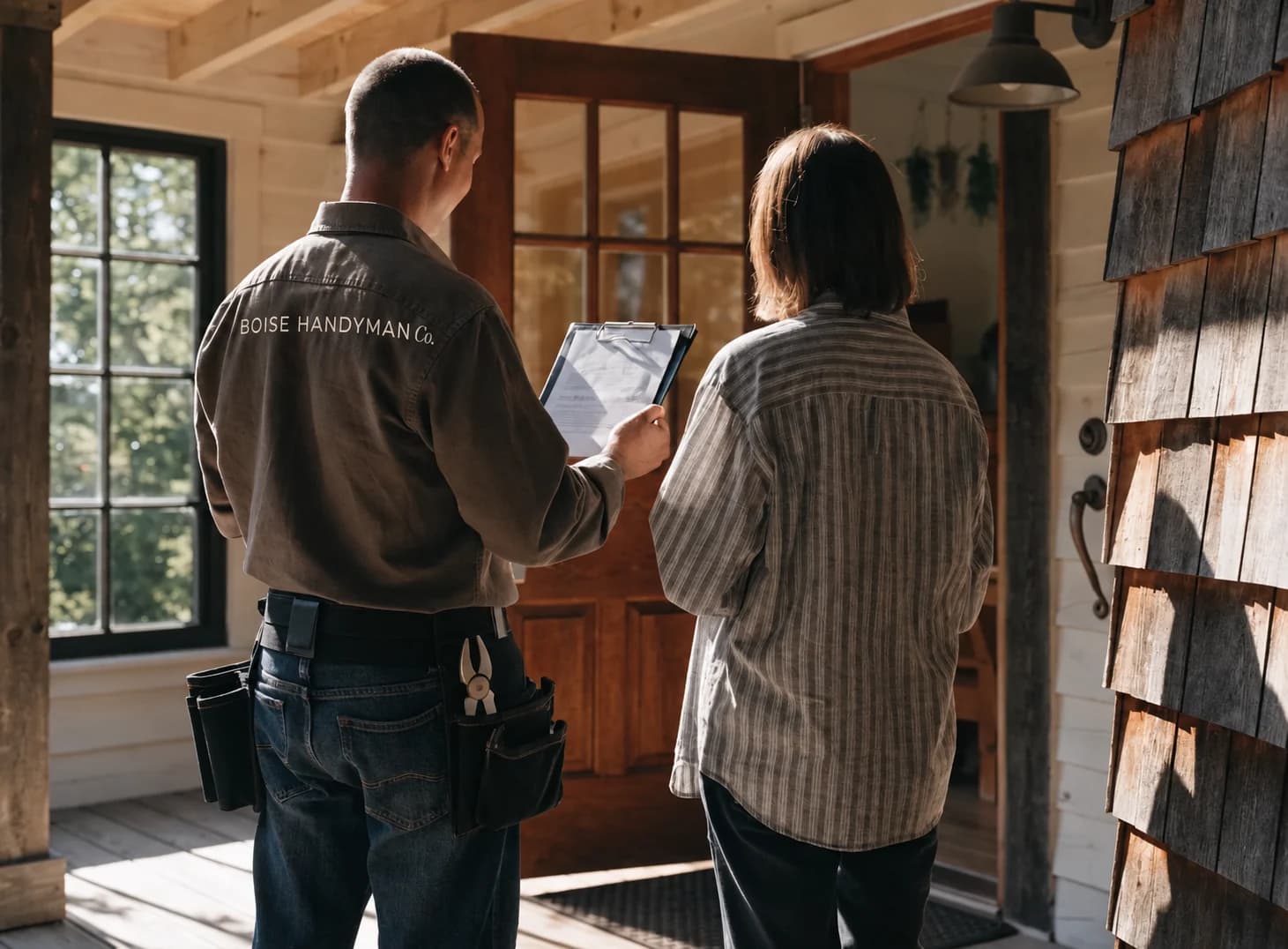
The short version
Hiring well comes down to four moves: define the job in writing, compare like-for-like quotes, verify insurance and licensing where it applies, and read recent local reviews for specifics. Do those four things and you will filter out nearly every bad outcome before it reaches your house. The rest of this guide walks through each one, plus the pricing mechanics and the warning signs, in the order you will actually meet them.
It is worth saying plainly: this guide applies to us too. Everything we suggest you demand from a handyman, written flat quotes, proof of insurance, honesty about scope limits, is what we expect you to demand from Boise Handyman Co, and we would rather earn the job through that filter than around it.
Step one: describe the job before you ask the price
A written job description with photos is the highest-leverage five minutes in the whole process. "Some drywall damage in the hallway" gets you a guess. "Two holes about fist-sized in textured drywall, hallway, plus a door that drags on the frame, photos attached" gets you a real number, often without a site visit. It also makes every quote answer the same question, which is the only way comparing them means anything.
Walk the house once and write the full list, not just the item that prompted the call. Small jobs share trip costs, so a pro quoting five tasks in one visit will nearly always beat five separate calls, and you will get the whole list handled instead of the loudest item. The cost mechanics of batching are covered in the Boise home repair cost guide.
Step two: build a shortlist worth quoting
The best leads come from people whose houses you can see, not from whoever spent the most on ads. Neighbors, coworkers, and local community groups will tell you who showed up on time, who came back to fix the one thing that squeaked, and who stopped answering the phone. Two or three names is enough: quoting is work for the pro and for you, and the goal is a decision, not a census. Response speed to your first message is data too, because it predicts response speed on everything that follows, including the callback when something squeaks.
The app marketplaces and lead platforms deserve a clear-eyed word: they are directories, not vetting. A profile on a platform means someone paid for a profile, and the reviews there are worth the same scrutiny as reviews anywhere. They can be a reasonable way to generate a shortlist in a hurry, but every check in this guide still applies to whoever the app produces, and a local operator with a fixed identity, a real service area, and neighbors who know their work will usually outlast a lead-chaser on every measure that matters after the first visit.
When you look at reviews, weigh recency and specificity over the star average. "Fixed our fence gate and re-caulked two showers in one visit, quote matched the invoice" is signal. A five-star average built on one-line reviews from three years ago is not. Pay particular attention to how a business responds when something went wrong, because every business eventually has that review, and the response is where the character shows.
Step three: check insurance, and licensing where it applies
In Idaho the licensing question has a precise answer: general handyman work is not licensed, but specialty trades are. Electrical, plumbing, and HVAC work beyond minor repair and like-for-like replacement must be performed by licensed tradespeople, and larger projects trigger contractor registration and permits. What that means practically: a handyman replacing a faucet or a light fixture is operating normally; a handyman offering to rewire your kitchen or move your plumbing is offering to do work the state says he should not.
Insurance is simpler: ask for a certificate of general liability insurance, and expect an unbothered yes. If a ladder goes through a window, or worse, a person comes off the ladder, insurance is the difference between the pro's problem and your problem. Which repairs trigger permits, and who to call in Ada and Canyon County to check, is laid out in when a home repair needs a permit.
Step four: get quotes that actually commit to something
A quote is useful when it pins down four things: scope, price, materials, and change handling. Scope means the tasks are named specifically enough that you could check them off. Price means a flat number for defined work, or an hourly rate with estimated hours for open-ended work, never a bare rate with no estimate. Materials means you know who buys them and whether they are inside the number. Change handling means the quote says what happens when the wall is opened and the job grows: the answer you want is that work stops and you approve the change before it is billed.
When quotes come back far apart, the difference is nearly always scope rather than skill. One includes repainting the patched wall; the other leaves you with a bare spot of mud. One includes haul-away; the other leaves the old fence panels by the curb. Line the quotes up item by item before you look at the totals, and treat a dramatic outlier as a description of a different job.
The red flags, in order of how fast you should walk
Some warning signs are worth a question; a few end the conversation. The end-the-conversation list: a demand for full payment up front, pressure to sign today because the price expires, and an offer to do licensed-trade work like panel replacement without the license. The slow-down list: cash-only with no written anything, a deposit request on a one-visit job, a quote produced without seeing the job or photos of it, vagueness about insurance, and no fixed business identity, no reviews, no address, a phone number that changes.
None of these mean a person is dishonest; all of them mean your protection depends entirely on their goodwill, which is precisely what paperwork exists to not depend on. The complete list, with the reasoning behind each, is in handyman red flags.
Paying: what is normal in this market
For a one-visit repair, the norm is simple: work is done, work is inspected, work is paid. Card, check, or transfer, with an invoice that matches the quote. A materials payment in advance is reasonable when something has to be special-ordered, and progress payments are normal on multi-day projects, but a typical handyman job is neither. Keep the invoice: it documents the work for warranty purposes and for whoever buys your house someday.
On the receiving end, expect to walk the work before paying. A pro who finished a texture-matched drywall patch wants you to look at it in raking light, because that is where the craft shows. Ours comes with a workmanship guarantee on the labor, and the invoice says so in writing. Communication norms are worth setting at the same time: how you prefer to be reached, whether photos of finished work are wanted when you are not home, and who else in the household can approve a change if a surprise appears mid-job. Five sentences at booking prevents most of the friction small jobs ever generate.
The real prize: a handyman you keep
The hiring process above is front-loaded work, and the return on it is that you only do it once. A handyman who knows your house, which doors swell in July, where the sprinkler valves hide, what got fixed last year, works faster and catches problems earlier than a stranger ever can. Most of our long-term clients converged on the same rhythm: a running list on the fridge, a call when it hits four items, a seasonal visit that works the list and eyeballs the usual suspects.
That rhythm is what our home maintenance service formalizes, and the season-by-season version of the list is in the complete Boise home maintenance guide. It is the cheapest way a house gets looked after: small problems, found small, fixed small.

When the answer is not a handyman
Some jobs should never be on a handyman's schedule, and hearing "that is not us" is a mark in a company's favor. Re-roofs, HVAC replacement, whole-house repipes, panel and service upgrades, additions, and structural work belong with licensed specialty contractors, with permits and inspections doing their jobs. The same is true mid-repair: when a small fix uncovers a big problem, rot beyond a sill, wiring that predates safety, the right move is to stop, show you, and help you get the right people in.
We hold that line as a policy. Handyman work done well is a real specialty, the one-to-eight-hour job, quoted flat, finished in one trip, and it is worth hiring someone who treats it as one rather than as a stepping stone to work they are not set up to do.
Contracts, warranties, and the paper that matters
Small jobs do not need long contracts, but they do need three pieces of paper: the written quote, the invoice that matches it, and a stated workmanship warranty. The quote is the agreement; for handyman-scale work a clear email or text thread naming scope, price, and materials handling does the job of a formal contract, and its real function is that both sides can reread it. The invoice should reconcile to the quote line by line, with any change traceable to an approval you gave before the extra work happened. Keep both: they document the house's history for warranty claims, insurance questions, and the buyer who eventually asks what was done and by whom.
The workmanship warranty is the piece people forget to ask about. It answers one question: if the repair fails because of how it was done, who pays for the redo? A confident answer, ours is that labor is guaranteed and we come back and make it right, costs a good operator almost nothing to give, because callbacks on well-done small work are rare. A vague answer tells you where the risk of a marginal job will land. Note the distinction from manufacturer warranties: the fan that dies young is the maker's problem and your receipt's, which is one more reason the materials question from earlier, who supplied what, belongs in writing.
Matching the job to the right kind of pro
"Handyman" covers a range of specialties, and matching your job to the right one is part of hiring well. Finish-sensitive work, texture-matched drywall repair, trim carpentry, paint that has to blend, rewards someone who leads with photos of that exact work. Wet-and-wired small jobs, faucets, valves, and fixtures or outlets, switches, and fans, reward someone who names the licensed-trade boundary without being asked. Exterior work, fences, decks, and gutters, rewards someone who talks about posts and water rather than pickets and looks. And list work, the accumulated punch list, rewards someone organized enough to quote ten small items as one coherent visit.
Ask what a pro does most, and listen for specifics. "Everything" is a marketing answer; "a lot of drywall and door work, and seasonal maintenance rounds" is a real one. The follow-up question that sorts the field fastest: "What jobs do you turn down?" Every good handyman has a ready answer, because holding a scope line is half the trade. Anyone who has never met a job they would not take is telling you how your gas line will be treated.
Hiring around the valley: what changes by city
The vetting process is identical everywhere, but the jobs you are hiring for differ by housing stock, and a pro's familiarity with yours is worth asking about. Boise's older neighborhoods need someone comfortable with plaster, old doors, and the surprises of century-old walls. Meridian, Kuna, and Star are dominated by newer subdivision homes, where the work is settling repairs, builder-grade part swaps, and installs, and where HOA rules can shape exterior repairs. Eagle and the foothills communities bring larger homes, higher finish expectations, and more exterior surface per house. Nampa and Caldwell span the whole range, from early-1900s homes near their downtowns to phases still being built, and Middleton adds acreage properties where batching a list into one visit is the only economical way to buy small work.
We wrote up what each area's homes actually need in our city guides: Boise, Meridian, Eagle, Nampa, Kuna, Star, Middleton, and Caldwell. Whoever you interview, ask them the question those guides answer: what do houses like mine usually need? A pro who knows your neighborhood's stock will answer in specifics, and the specifics are the credential.
What a good first visit looks like
The first visit is an audition for a long relationship, and the tells are all observable. A good first visit starts on time or with a message when it will not. The pro walks the job with you before touching anything, confirms the quoted scope out loud, and flags anything the photos did not show while it is still a conversation rather than an invoice. Shoes come off or covers go on without being asked. The work area ends cleaner than it started, old parts are offered rather than vanished, and the invoice matches the quote to the dollar or comes with an explanation you heard before the work happened.
Afterward, the durable tells: the small thing that squeaks a week later gets fixed without a fight, texts get answered inside a business day, and the next quote arrives as promptly as the first one did, because good operators treat the tenth job like the first. When you find this, keep it, a handyman who knows your house is worth more each year, and the seasonal rhythm described in the maintenance guide is the natural shape of the relationship. What each visit should cost along the way stays anchored by the cost guide.
Put us through the filter
If you have a list, run the process on us. Send the list with photos and you will get back a written flat quote that names the scope, the price, and how changes are handled, and you are welcome to put the same screening questions to us, insurance included. If part of your list belongs with a licensed trade, the quote will say that too. That is the standard this guide asks you to hold everyone to, and we wrote it because we are comfortable being held to it.