What this climate does to the outside of a house
Treasure Valley exteriors take damage from two directions: summer works from above, winter from below. Summer is high-desert sun, months of intense UV with afternoons over 95, which chalks paint, embrittles caulk, grays deck boards, and fades anything facing south or west a year or two ahead of the shaded sides. Winter is the freeze-thaw engine: dozens of nights below freezing, many following days above it, so any water that got into a joint, a post hole, or a paint crack expands, pries, and re-freezes on a cycle. Add wind that tests every fence in the valley and irrigation systems that keep summer ground wet, and you have a climate that is perfectly survivable for a house, provided somebody patrols the perimeter twice a year.
That patrol is this guide. Fences, decks, gutters, siding, and paint each get their own section: what fails here specifically, what repair costs, and the upkeep that keeps repair rare. All of it is the territory of our fence, deck, and gutter service and exterior painting service.
Fences: it is almost always the posts
A fence fails from the ground up: pickets and rails weather cosmetically, but posts fail structurally, and a leaning fence is a post problem wearing a fence costume. Freeze-thaw and irrigation-wet ground loosen posts at the ground line, buried wood rots on its own schedule, and the valley's spring wind events find every weak one. The good news is that fences are modular: resetting or replacing the affected posts and re-hanging their sections runs $150 to $450 per section, and a fence can be renewed that way for years before whole-fence replacement makes sense.
The upkeep that stretches fence life: fix the first leaning post rather than the fifth, keep sprinkler heads from soaking post bases, re-screw popped pickets before wind claims them, and keep gates adjusted, a dragging gate levers its hinge post loose a little more every swing. Gate repair and re-hanging is one of our most common calls, and it is an hour's work when done at the dragging stage instead of the fallen-over stage.
Gutters: cheap insurance for the foundation
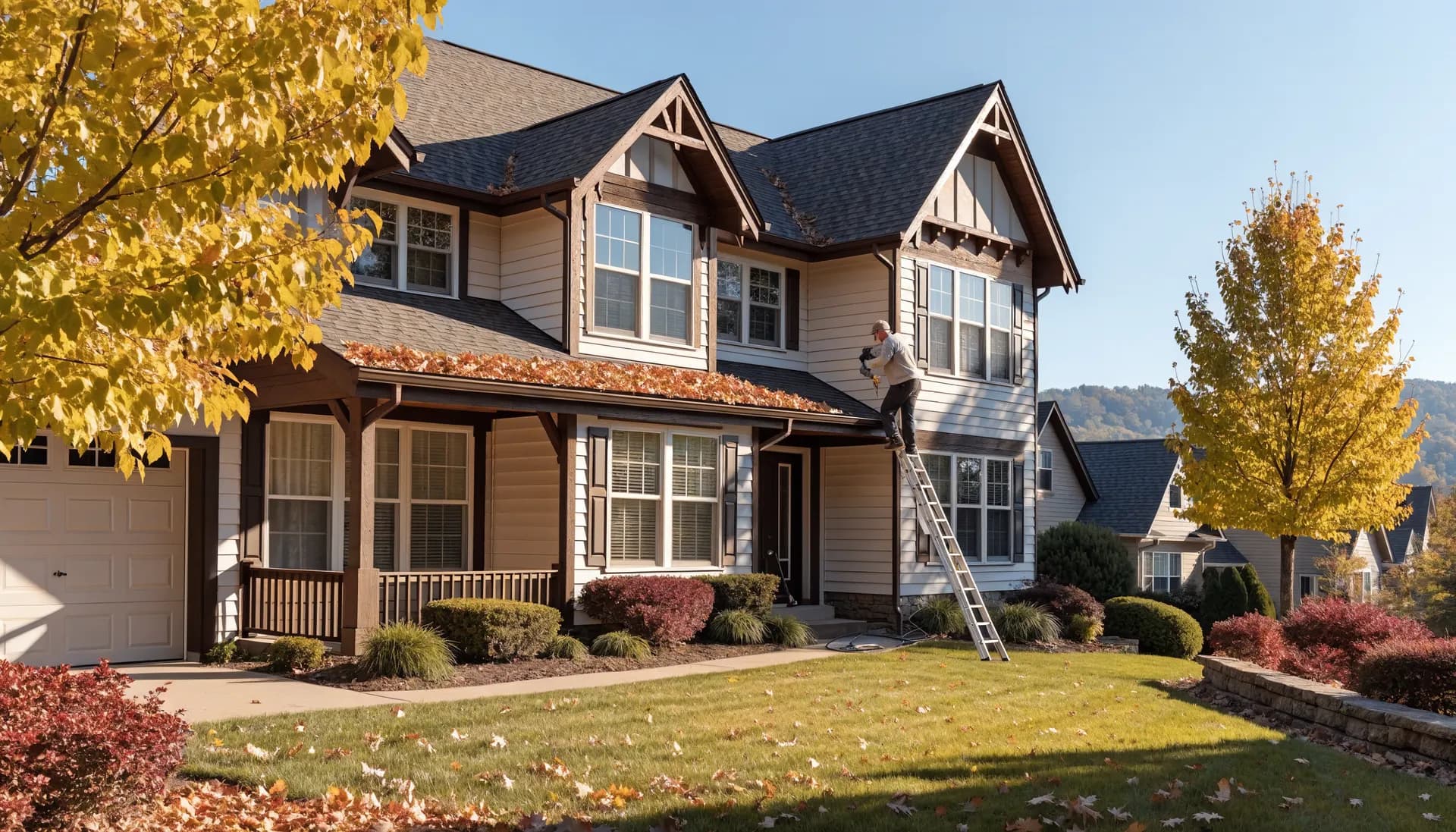
Gutters exist to move roof water away from the foundation, and everything bad they do, they do when clogged. A blocked gutter overflows at the eave, soaking fascia boards until they rot, and dumps concentrated roof water in a line beside the foundation, exactly where you least want it. In winter, clogged and overflowing gutters contribute to ice dams. The whole failure chain is prevented by cleaning, once each fall after leaf drop, twice yearly under Boise's mature-tree neighborhoods, at $100 to $250 for a typical single-story home. Two-story homes and complex rooflines cost more for the honest reason that ladder time is the job, which is also why gutters are the classic hand-it-to-a-pro task even for committed DIY households.
While the ladder is up, the five-minute inspection: hangers tight, seams not dripping, downspouts connected and discharging at least a few feet from the house, extensions where splash blocks have wandered off. Sagging runs, separated seams, and rotted fascia behind the gutter are all repairable at the section level through our gutter repair service, and fascia caught before rot spreads is a trim repair rather than a carpentry project.
Downspout extensions are the cheapest structural protection in this entire guide and the most commonly missing. A downspout that ends at the foundation concentrates an entire roof plane's water into one spot beside the house, every storm, every melt. Extensions that carry discharge even a few feet out, onto splash blocks or into buried drain lines where they exist, change the water's destination for less than the cost of a tank of gas. While checking them, glance at winter behavior too: a downspout that discharges across a walkway becomes an ice sheet in January, and rerouting it in October is a five-minute job that prevents a season of hazard.
Decks: gray is fine, soft is not
The screwdriver test sorts every deck concern in ten seconds: press the tip into the wood, firm is weathering, soft is rot. Gray, checked surface boards are UV damage, cosmetic, and reversible with a wash and re-stain, which the valley's long dry summers make easy to schedule. Soft wood at board ends, around fasteners, at rail posts, or anywhere near the house is water damage and needs repair: individual board and rail replacement runs $150 to $500 depending on count and how the material matches what is there.
Two spots deserve special attention every spring. Rail posts, because a rail that gives when leaned on is a safety item, not a cosmetic one. And the ledger zone where the deck meets the house, because that is the joint whose failure matters most; if flashing there looks compromised or the wood near it is soft, that is the moment to get a professional eye on it. Structural framing and ledger work belong with a contractor; boards, rails, stairs, and refinishing are squarely handyman scope, and we hold that line honestly.
Siding, trim, and the caulk that guards them
Water gets into walls at the joints, siding to trim, trim to trim, and around every penetration, which makes exterior caulk the cheapest structural protection on the house. Our UV embrittles caulk on sun-facing sides in a few seasons, and once a line cracks or pulls away, every rain and every sprinkler pass feeds the gap, with freeze-thaw prying it wider all winter. Walk the sunny sides each spring and fall: caulk that has opened, paint that has cracked at horizontal trim, and any siding spot that stays damp are all this-season items, not someday items.
Repairs at this stage are small: re-caulking the failed joints, replacing a length of weathered trim, patching and priming a damaged siding section, standard visits under our caulking and maintenance and carpentry and trim services. The same walk should glance at the sprinklers: a head that hits the house is doing daily damage on a timer, and re-aiming it is free.
A word on pressure washing, because it is the most misused tool on the exterior: used gently and at distance it cleans siding, concrete, and pre-stain decks well, and used close and hot it drives water behind siding laps, gouges soft wood, and strips paint you were not planning to repaint. Fences and decks in particular want low pressure and patience, the goal is clean wood, not furrowed wood. If a surface needs aggressive pressure to come clean, that is usually the surface telling you it actually needs refinishing, and the honest fix is the stain or paint, not a harder blast.
Exterior paint: maintenance, not makeover
In this climate, exterior paint is a wear item on the sunny sides, and touch-ups are how you avoid buying whole repaints. South- and west-facing trim and doors chalk, fade, and crack two to four years ahead of the shaded sides. Annual touch-up of those exposures, sand, prime, and paint the failing spots, plus fresh caulk at the joints, keeps the envelope sealed and pushes the full-repaint date years out. Front doors deserve their own line: they take the most UV and the most use, and repainting one transforms the approach to the house for a few hundred dollars. Stained fences and pergolas follow the same sun logic as decks: the south face grays first, the finish fails at the top rails where water sits, and a re-coat applied while the old finish is merely faded costs a fraction of the strip-and-restore that waiting buys.
Timing matters here more than technique: exterior paint wants warm, dry, not-scorching days, which makes late spring and early fall the valley's best windows. Touch-ups and single-side repaints are our painting service's bread and butter, starting at $199; whole-house repaints are a painting-contractor project, and we will tell you when your house is due for one instead.
The exterior year, in one table
The whole guide compresses to a two-patrol rhythm, spring and fall, with summer for projects and winter for watching.
| Season | Exterior tasks |
|---|---|
| Spring | Walk all four sides; screwdriver-test the deck; check fence posts and gates after wind; run sprinkler zones and re-aim heads; note failed caulk and paint on sunny sides |
| Summer | Do the projects: re-stain the deck, repaint trim and doors, repair fence sections, replace weathered boards; keep condenser and siding clear of debris |
| Fall | Clean gutters after leaf drop; confirm downspouts discharge away from the house; final caulk pass before freeze; disconnect hoses; stow or secure what wind can throw |
| Winter | Watch: icicles and ice dams at eaves, fence response to wind events, water pooling against foundation during melts |
The interior half of this calendar lives in the complete Boise home maintenance guide, and the printable combined checklist is on our resources page.
What exterior repairs cost here
Exterior repair pricing in the Treasure Valley is consistent enough to plan against. Fence section repair $150 to $450; gate repair or re-hang $100 to $300; gutter cleaning $100 to $250 with minor repairs commonly $100 to $350; deck board and rail replacement $150 to $500; exterior caulk refresh a few hundred dollars for a whole house; trim repair and touch-up paint $150 to $500 by extent. Our services carry flat starting prices, fence, deck, and gutter from $149, painting from $199, and every job is quoted firm from photos before we arrive.
The pattern to notice: every number in that paragraph is smaller than the number it prevents. The fence section beats the fence; the fascia repair beats the fascia-and-soffit rebuild; the caulk line beats the wall opening. Exterior maintenance is the clearest case of the deferred-repair multiplier anywhere on a house, because outside, water always gets another try. The full cost logic lives in the Boise home repair cost guide.
Everything else on the perimeter: concrete, garage doors, screens, and grades
A few exterior items sit outside the fence-deck-gutter trio but belong on the same patrol, because they fail by the same physics. Concrete walks and driveways move with freeze-thaw: a new trip edge where two slabs used to align is worth noting, and the joints and cracks that let water under the slab are the mechanism, caulking wide concrete joints is unglamorous and genuinely useful. Garage doors want their hardware looked at yearly, hinges, rollers, and the bolts that vibration loosens, plus a photo-eye test; spring replacement is a specialist job with real stored energy in it, and it is one of our standing referrals rather than a repair we attempt. Window screens, storm doors, and weatherstripping around the garage man-door round out the small stuff: cheap parts, quick swaps, and a surprising share of a house's drafts and bugs.
The last item is the ground itself. Walk the foundation line once a year and confirm the grade still slopes away from the house, flower bed edging, bark refreshes, and settling all conspire to reverse it over time, and a low spot against the foundation is a standing invitation to every melt cycle. Downspout extensions solve most of what you find; genuine regrading and drainage engineering belong with specialists. None of these items is dramatic, which is the point: the exterior stays cheap to own precisely when nothing on it ever gets to be dramatic.
The valley's two special forces: wind and irrigation
Beyond sun and freeze, Treasure Valley exteriors answer to two local forces that national maintenance advice never mentions: wind and irrigation. Wind is strongest where the ground is open, Kuna, Star, Middleton, and the foothills edges of Eagle and Boise, and its favorite target is whatever was already marginal: the fence post loosened by freeze-thaw, the gate that never latched, the picket with two rusted screws. The economics are unforgiving in the right direction: the post fixed in April is a $200 repair, and the same post after the May windstorm is a three-section rebuild, plus whatever the falling section landed on. Trampolines, patio umbrellas, and unanchored shade sails belong in the same paragraph, because the valley's spring gusts relocate all three annually. After any significant blow, walk the perimeter and photograph what moved.
Irrigation is the quieter force. From April to October, most valley yards are watered on a timer, and any head misaimed at the house waters the siding with the same discipline. A sprinkler soaking a fence post, a deck support, or the same patch of wall every morning does more cumulative water damage than the valley's entire annual rainfall. The five-minute spring fix: run each zone once and watch where the water actually lands, then re-aim or flag anything hitting wood or siding. It is the highest-return five minutes in this entire guide.
Exterior priorities around the valley
Every neighborhood in the valley runs the same physics, but the housing stock decides which chapter of this guide matters most. Boise's older neighborhoods lead with gutter duty under mature trees and paint upkeep on original wood siding and trim. Meridian's newer subdivisions lead with fences, vinyl and cedar runs tested by wind and often governed by HOA standards, and young-tree gutters that stay easy for another decade. Eagle and the foothills communities lead with scale and exposure: more deck, more trim, more weather-side wear per house. Kuna and Star lead with wind, full stop. Nampa and Caldwell split between old-core homes that need the older-stock program and new edges that need the subdivision one, and Middleton adds acreage perimeters where one batched visit is the only sensible format.
The area guides carry the specifics: Boise, Meridian, Eagle, Nampa, Kuna, Star, Middleton, Caldwell, plus the Eagle Foothills, Hidden Springs, and Harris Ranch. Wherever you are, the same rule closes the loop: exterior problems are cheapest the season they appear, and the hiring guide covers how to vet whoever you have fix them.
Walk the house, send the photos
Start with one slow lap of the outside, phone in hand, photographing anything leaning, soft, clogged, cracked, or peeling. That lap takes fifteen minutes and produces exactly what we need to quote the fixes flat: send the photos over and you will get back a firm price and a one-visit plan, usually within a day. If something in the photos is bigger than handyman scope, a failing ledger, a fence past saving, a roof issue, we will name it and point you at the right kind of contractor instead of guessing at it ourselves.